

'We had a chip on our shoulders': The inside story of WEC's defiant final night, 15 years later
When it was over, one fighter would remember only disappointment and heartbreak. Another would wonder if he might have just accidentally killed a man. Yet another would regard the night as one of the lowest and darkest moments of a long career, the point at which he’d just about concluded that he and professional fighting had nothing left to offer one another.
It was 15 years ago today — Dec. 16, 2010 — that World Extreme Cagefighting (better known as the WEC) held its final event. A bittersweet farewell, in many ways.
On one hand, WEC 53 would later be remembered as one of the promotion’s best and most-watched shows, drawing well over a half-million viewers on the Versus Network. Of the four fighters featured in the main and co-main event, three went on to be UFC champions. The headlining bout also produced an all-time great MMA highlight — known now simply as “The Showtime Kick” — that left the crowd of 6,300 simultaneously stunned and thrilled and confused.
On the other hand, it marked the end of the line for a fight promotion that was beloved by hardcores and largely ignored by almost everyone else.
WEC started in 2001 as a regional fight promotion in Northern California, running most of its early events out of the Tachi Palace in Lemoore, just outside Fresno. But in 2006, it was purchased by Zuffa, the parent company of the UFC, and change inevitably followed.
The most significant of those changes was to transform it into Zuffa’s exclusive home for smaller fighters. At the time, the lightest weight class featured in the UFC was the 155-pound lightweight division. The WEC, however, included featherweights (145 pounds) and bantamweights (135 pounds), in addition to lightweights. It served as a test case for Zuffa, which seemed skeptical that audiences would ever show up in profitable numbers to see the smallest fighters in the sport.
At times, they did. During his time as WEC featherweight champion, Urijah Faber was a genuine star for the organization. Other fighters like Jose Aldo, Dominick Cruz and Donald “Cowboy” Cerrone would later become stars in the UFC. But as 2010 wound down, Zuffa was ready to consolidate. The WEC roster — some of it, anyway, though no one was entirely sure how much of it — would be absorbed into the UFC, creating two new weight classes with two new champions.
The final order of business before the WEC could roll up its blue canvas and disassemble its smaller, cozier cage once and for all? An event to end the year with a bang and send the organization itself out on a high note. WEC 53 accomplished that. But it also provided a glimpse of the future, in more ways than one.
Of all the things to stick in his memory, it’s the online fan poll that sticks out for Benson Henderson. A quaint idea by today’s standards. The kind of thing your grandmother might post about on Facebook. But in 2010, these tools of the information superhighway were still novel enough to be interesting — especially for those with a stake in the outcome.
The pitch was that, for its final event, WEC would let fans choose the location. The initial list offered 30 different cities as options. Before long two frontrunners emerged: Phoenix, Arizona and Milwaukee, Wisconsin. Henderson, the reigning WEC lightweight champion, had adopted Phoenix as his home. Anthony Pettis, the looming challenger for his belt, was a well-known Milwaukee guy. And since the contest allowed each user to vote as many as 10 times per day, things snowballed quickly.
“I remember every day for a month, or probably even longer than that, people were sending me these screenshots and pictures of how many times they voted for the card to come to Phoenix,” Henderson told Uncrowned. “I know a ton of Wisconsin people were voting to get it there, but I had friends, family, old college roommates — everybody I knew, basically — sending me screenshots of them voting for it over and over every single day until Phoenix won.”
It would be the first time in Zuffa history that the company promoted an event in Arizona, but the fan vote was just one of several things that made the final event feel different.
Dave Sholler, the WEC’s public relations manager at the time, remembers heading into Phoenix that week with the palpable sense that everyone involved had something to prove. The promotion had spent the past couple years trying, with mixed results, to get out of the UFC’s colossal shadow. Many fans still regarded it as a little brother organization, filled with fighters either not quite big enough or good enough for the UFC. It didn’t seem to matter how many memorable fights the organization put on. It was the perception that stuck.
“I remember that show just having a different energy in the building,” Sholler said. “We had a chip on our shoulders, and we took pride in that. The fighters, the staff, everybody on the team. I remember [WEC co-founder] Reed Harris and I would go to every city we visited with a WEC duffel bag full of VHS highlight reels and press kits. It was hard in 2009 to get people to cover us in local markets like Youngstown, Ohio, or San Antonio or Edmonton. We were grinders. We had this sense of satisfaction and pride at having built this challenger brand with a cult following, but now it was ending.”
Sholler was one of the lucky ones. He’d already been told that, when the WEC was absorbed by the UFC, he’d still have a job. In fact, he was getting something of a promotion. The end of the WEC meant getting called up to the big leagues, and just as the UFC was really taking off as a mainstream sports brand.
But not everyone had such job security as the fans filtered into Jobing.com Arena that night. Many of the fighters on the WEC roster had only been told that the UFC would be taking some of them. Outside of the reigning champions and a couple top draws, it wasn’t at all clear who would make the cut. For many, that final event offered one last chance to make a strong case for themselves.
That’s how it was for Danny Downes, a lightweight who came into that event on the heels of a submission loss earlier that year. He’d been matched up against Zhang Tiequan, “The Mongolian Wolf,” an undefeated Chinese fighter who the parent company Zuffa seemed to be hoping would aid future international expansion efforts.
“I’ll always remember standing there behind the curtain before that fight,” Downes said. “I know my career’s on the line. I know that if I go 0-2 I’m not getting brought over to the UFC, and that was my whole focus. I wanted to fight in the UFC. Then Reed Harris comes by and he’s like, ‘Man, all the fights have been good … so far.’ And he just looks at me.”
This was about the time when Downes started to get the distinct impression that perhaps he hadn’t been booked in this fight because the promoters thought he’d win. (Harris did not respond to requests for comment.) And the thing is, the fights had been good. Of the first six bouts at WEC 53, five ended with first-round finishes, some of them quite dramatically. Downes felt the pressure to keep that going, but also to keep his career viable in the process.
“The other thing [Harris] did was say something like, ‘Hey there’s 80 million people watching in China right now. Anyway, have fun.’ And then, boom — right after he said that my walkout music starts playing,” Downes said. “I was like, well, here we go.”
Downes proved up to the task, handing Zhang his first professional loss via unanimous decision. Both would go on to get their shots in the UFC. But others weren’t so lucky.
For former WEC lightweight champion Jamie Varner, the end of the WEC seemed like it might also be the end of his fighting career. At one point, he’d been a vocal proponent for the organization, hyping it up to anyone who’d listen. But a series of events had made him feel abandoned and discarded by the WEC. At the same time, he felt his own passion for the sport draining away.
“I had lost my heart, my will to fight,” Varner said. “Even my training was s***. My mind wasn’t in it. I hated fighting. Hated it. I was just doing it to get a paycheck. I was pretty banged up and injured, so I probably shouldn’t have even fought on that Phoenix card, but I hadn’t fought in Arizona in years. That was my backyard. Still I think I only trained for like three weeks for that fight. I was just lost and trying to find myself.”
That night Varner faced Shane Roller, a decorated wrestler who’d been essentially recruited into MMA by Team Takedown, a well-funded effort to turn collegiate wrestlers into top MMA fighters. Varner lost the fight via first-round submission, feeling the entire time like he was just going through the motions.
“I didn’t really want to fight, but I still ended up dropping him with a left hook, which is crazy,” Varner said. “Then I went for the finish and I slipped. He ended up taking my back and I got choked, which just felt like a sign from God that I was just f***ing done.”
Elsewhere on the undercard, bantamweight Eddie Wineland took on Ken Stone, a former college wrestler with a solid 9-1 record as a pro. Wineland, like many others, didn’t know for sure if he’d be picked up by the UFC once the night was over. He felt he needed to make an impression.
So when Stone jumped guard in search of a guillotine choke, Wineland calmly carried him over to the fence to rest his body weight against the chainlink. Once Stone made the mistake of releasing the choke without releasing the guard, Wineland snapped him down to the mat in a vicious slam.
The dull thud of Stone’s body and head hitting the mat reverberated through the entire arena, followed by the guttural groan of nearly 7,000 people who seemed to be questioning their decision to seek out sanctioned violence on this particular evening.
Wineland went directly into his celebration, jogging around the cage and basking in the victory. Stone didn’t move. He lay sprawled out on his back, arms out at his sides, entirely unresponsive. He stayed that way for a long time. Long enough, in fact, for Wineland to fear the worst.
“That one really left me unnerved,” Wineland said. “Because he just wasn’t moving at all. Yes, we're in a sport that’s violent, but you're not there maliciously to hurt somebody. You're there for the sport.”
By the time he got back to the locker room, the mood around Wineland had darkened. No one was celebrating the first-round knockout. Not really. They should have been high-fiving and hugging, looking ahead to the after-party and the UFC contract that would follow. But it was hard to work up the enthusiasm as they watched Stone’s limp body get loaded onto a stretcher and wheeled out of the arena.
“He was completely unconscious for the entire time they were taking him out of there,” Wineland said. “So it kind of sucked back in the locker room. I’m thinking, 'Did I really hurt this guy? Did I kill this guy? What then?' Finally, someone came in and told us that he was in the ambulance and he’d started moving again and he seemed like he was going to be OK. Then I could breathe again. But after that, it was hard to really get excited again. It was kind of like, 'Now what?'”
The top two bouts of the evening were for big stakes. In the co-main event, WEC bantamweight champion Dominick Cruz defended his belt against Scott Jorgensen, a former Boise State wrestler on a five-fight win streak. The fight would determine more than just who went down in history as the last 135-pound champion in the WEC. Whoever won would also become the first UFC bantamweight champion, earning an instant promotion when the UFC adopted this new weight class.
All week, Cruz had been the picture of supreme confidence. Jorgensen had no chance against him, he told reporters at the pre-fight media day. The speed and the style, it would all be too much for him, Cruz said. When informed that Jorgensen’s friend and training partner Joe Warren had promised that a big surprise was in store for the champ, Cruz just smiled.
It turned out he had good reason to. Once the bout began, Jorgensen looked like a man trying to fight a swarm of bees. Cruz darted in and out, stinging with him lead rights and then baffling him with knee-tap takedowns. It all looked the same on the way in, like a skilled relief pitcher whose arm movement seems identical whether he’s throwing a curveball or straight gas.
As the one-sided fight wore on, it was Warren’s voice from Jorgensen’s corner that rang out in the building.
“Put your hands on him, Scotty!” Warren shouted over and over again. But Jorgensen couldn’t find Cruz, much less touch him. Watching Cruz pile up rounds with his mongoose-like attacks felt like watching an artist develop an entirely new style of painting. Jorgensen, like most of Cruz’s opponents back then, was still looking for his brush.
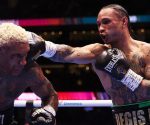
Yet all these years later, it’s the main event of WEC 53 people remember best, even if they also tend to remember one part of it incorrectly. In their minds, that incredible kick Pettis landed in the final minute of the final round — jumping off the chainlink cage with one foot, then swinging it around to land a kick to Henderson’s head, like something out of a Jackie Chan movie — was the finishing blow. They don’t always remember that, while he was dropped as much by the surprise of the move as the force of the strike, Henderson survived and made it to the scorecards.
When he thinks back on it now, Henderson can’t help but think about all the good moments he had in that fight before the Showtime kick put him in permanent highlight territory.
“The rest of the fight, all of those rounds could have went my way,” he said. “But that kick was such a dramatic moment. I could have won every moment up until then and that kick would probably still have won him the fight.”
The reaction in the arena when that kick landed was both baffled and awestruck. At first, people didn’t fully realize what they’d seen, in part because no one had ever seen it before. It all happened so fast. It was so different. Not until the replay aired in the arena while the judges’ scores were being tallied did people fully appreciate what Pettis had done.
As the decision victory was announced, Pettis glowed with a new aura. He’d go charging into the UFC as a somebody now, rather than just another lightweight folded into an already crowded division.
But for Henderson, it was a crushing loss. He showed up to the post-fight press conference, dutifully answering questions and playing the role of the good sportsman. But in between answers his face would change, grimacing in a mighty effort to fight off tears, at least while reporters were there to see them. It felt like you could almost see into his brain as he replayed those last couple minutes of the fight and processed all that it would mean for him.
“I just remember being so disappointed,” Henderson said. “Being home in Arizona, having my family and friends there. My teammates, their girlfriends and wives, everybody doing all that voting all day long to bring the show there. I felt like I let them all down.”
Also backstage, Varner was finding a strange silver lining in what had otherwise been one of the lowest moments of his professional life. He exited the fight with Roller with a cut on his eyelid, requiring stitches. The doctor offered him two choices: Have it closed at the hospital, which would likely require some waiting around, or tough it out right there and get it over with.
“He told me the cut was too close to my eye for him to really give me any lidocaine or numbing agent, so I’d just have to deal with the pain as he stitched it up,” Varner said. “I was like, f*** it, let’s do it. I was so defeated and just broken. But then the doctor, his name is Dr. Ara Feinstein, we got to talking and we became really good friends after that. He actually wrote me a letter of recommendation years later to help me get into medical sales. We stayed in touch, would hang out together. And all of that would have probably never happened without that fight.”
Though he thought his career was over, Varner later ended up fighting in the UFC. So did Downes, which at least gave him the satisfaction of being able to say that he got to the sport’s biggest stage. That was a point of pride for so many of the WEC fighters, but especially the lightweights. Theirs was a weight class the UFC already had, which made it all the more frustrating to explain to people how it was they came to fight for the UFC’s parent company but not the UFC itself.
“It was like when you were a kid and you needed an extra controller for your Super Nintendo or something, and you ended up with the off-brand stuff,” Downes said. “Like, why do I have to get stuck with the Mad Cats controller? It sucks. That’s how it felt trying to explain it to people. We were still good fighters even if we weren’t hanging out with Chuck Liddell or whatever. But people looked at it like the minor leagues.”
For Sholler, the ending left a bittersweet taste. He was moving on and moving up in his public relations career, eventually finding his way from the UFC to Harris Blitzer Sports Entertainment, where he represents teams like the Philadelphia 76ers and New Jersey Devils. But there was just something about those early days, learning the ropes and pushing the gospel of the WEC to skeptical newspaper editors and local TV news directors.
“I think back to some of the coolest moments in my career, working in the NFL, the NBA, the NFL, but some of my fondest memories are still the WEC,” Sholler said. “That’s where I learned about marketing and promoting athletes. That’s where I learned to sell tickets. I’d be lying if I said I didn’t shed a tear after that last press conference.”
He wouldn’t have been the only one. As they tore the WEC cage down and turned out the lights in Phoenix that night, there were many people who had only just begun to realize all that was truly going away. And it would never come again.