

NBA All-Star Weekend betting, lines, odds: How should a bettor approach the league showcase?
The NFL season is over, so it’s time to turn our attention to the NBA.
When betting the NFL, the hope with every pick is to bet early on Tuesdays, have a strong number by kickoff and bank on a sharp market to be efficient. The process and results matched. After sweeping three bets on the Super Bowl, the season ended 41-25, hitting 62% of my bets (with average odds of -115), and ending plus-14 units.
The plan for the NBA is mightily similar. I want to beat the closing line in an attempt to gain positive expected value.
Let’s break down NBA All-Star Weekend with a detailed approach to +EV betting that will be a weekly staple when the NBA returns from break.
Explaining theoretical hold, how to calculate it, and why it matters
Theoretical hold in sports betting refers to the average rake rate or house cut the casino/sportsbook expects to make in a given market. We know books make their money on the house edge obtained by placing a vig on bets customers place. In the most basic sense, if a bettor is hitting 50% of his or her bets on the standard -110 odds, he or she is going to be a losing bettor because of the juice, which requires a 52.38% hit rate to break even.
To calculate the theoretical hold, we take all betting options in a market, convert the odds into implied probabilities represented in percentages, sum the total (which will always be north of 100%) and subtract 100%. The leftover percentage of the summed implied probabilities is the expected house cut. So when applying this to a game spread or total, we typically see -110 on each bet side. If a -110 correlates to a 52.38% implied probability, then the sum total of two -110 bet options is 52.38 + 52.38 = 104.76%. Subtract 100%, and the book expects to make 4.76% in these standard two way markets.
Quick aside: The reason why it is theoretical is because sportsbooks' actual handle on a game is rarely 50/50 on both sides, so in a given market it depends which side wins and which betting side took the action. But the house edge of 4.76% still exists.
Applying that to NBA All-Star markets
When looking at the All-Star Weekend betting markets — for markets like 3-Point Contest winner, Slam Dunk Contest winner and All-Star Game MVP — there is a large spike in this theoretical hold. If we convert the current odds on all eight possible 3-Point contenders into implied probabilities, sum the total and subtract 100%, we find a theoretical hold in this particular market to be 13.6%. That means the house cut is expected to be nearly three times that in a standard game market.
When the house cut rises, the bettor's value decreases. Edges need to be bigger in higher hold markets to justify a bet being placed and to obtain positive expected value. In All-Star weekend, it is hard to know who is going to give maximum effort, let alone identify a true edge by studying player vertical for the Slam Dunk contest, or shot-form consistency metrics and release angles for the 3pt Contest. Understanding what theoretical hold is, how to calculate it and how to evaluate the number generated allows you, as a bettor, to evaluate that specific market and if it is worth exploring for edges.
Players I like
Despite this not being a market I chose to bet into, as a high-level NBA bettor and a massive NBA fan, I am happy to offer a few suggestions on players I like. I understand people will negate the need for a true edge on a small and entertaining bet. So here are the players I would most consider:
Devin Booker, 3-Point Contest winner (+550): Booker is having a down year from an efficiency standpoint, but he is a perfect candidate to target. This is Booker’s third time competing, and he already notched a win. Booker has a textbook release that is fit for this contest.
Looking at other candidates: Norman Powell was an instant cross off for me because the release point on his shot is at the top of his vertical, which is difficult to replicate on 30 shots in just 60 seconds. Jamal Murray and Kon Knueppel are making their debuts, and no thanks grabbing a first-time competitor with the nerves that are sure to hit. Bobby Portis has the longest odds and offers the biggest payout, but, to put it nicely, I am not sure why he is even in this contest.
Carter Bryant, Slam Dunk Contest winner (+190): No, he is not related to Vince Carter or Kobe Bryant, but hopefully he pays homage to those former winners. Carter Bryant is nearly a lab-built dunk participant. He has a 40-inch vertical, he is 6-foot-6 with just under a 7-foot wingspan. The measurables are ideal for this contest — Carter Bryant combines a mix of explosiveness and size to finish some awesome dunks. Look him up on YouTube, and you’ll see compilation videos of his dunks with titles like “He’s a Freak.”
Jaxson Hayes was my first easy elimination from this list. His size makes him too big to dunk with finesse. Hayes finished a midgame breakaway dunk through his legs in live action this season — go look it up. It sounds great in theory, but aesthetically it is underwhelming for a contest.
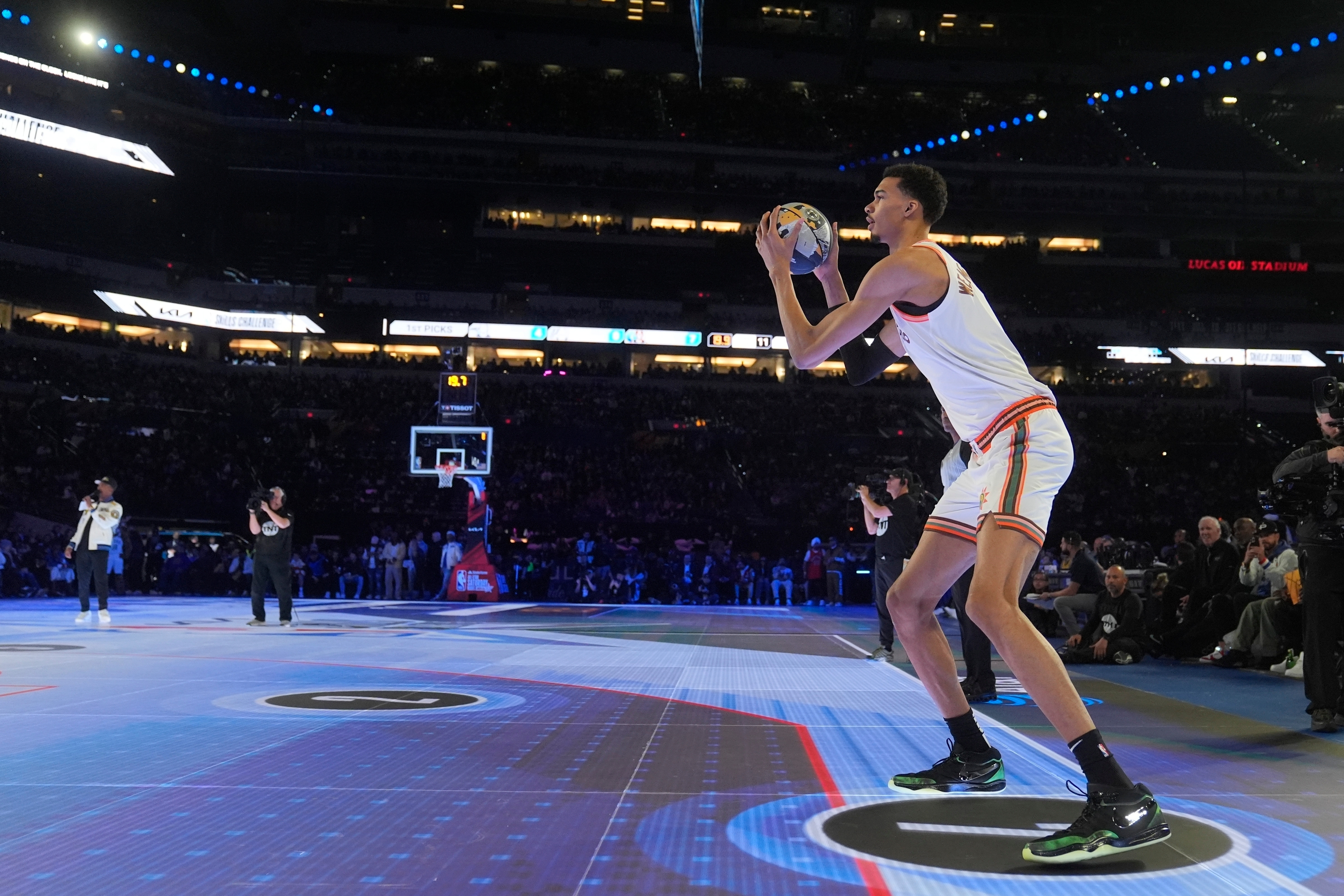
All-Star Game MVP Victor Wembanyama (+425): Wemby is the talk of the town heading into his first All-Star Game. Last year he tried to use game theory optimization alongside teammate Chris Paul in the Skills Competition by not even attempting shots and throwing three balls off the racks to qualify as shots and not waste time. While he was disqualified for doing so, Wembanyama is looking for edges and is outspoken that he is going to try.
The big advantage Wembanyama has is that he is a starter who promises effort and has a build that is guaranteed for an incredibly efficient game. Sure, he will probably shoot five-plus 3-point attempts, but those might be his only non-dunks. He will gobble up rebounds and maybe add some defensive stats and assists. Giannis was always my All-Star MVP favorite, and he took one home a few years ago, going 16-of-16 on easy dunks.
The best way to bet All-Star Weekend
Now that you have my picks, I will let you in on the best way to bet on the events.
There are 16 participants in Saturday’s contests, and you can add four possible candidates for All-Star Game MVP. That’s 20 players who can be put into an All-Star Weekend draft. Find a group of four and draft the participants until all the names are taken. You will have a collection of five contestants each, and if you have the winner in any specific market, you win, let’s say, $ 20 from each of your friends.
If you have Devin Booker, and he wins the 3-point contest, your three friends give you $ 20 each for a total of $ 60. Do this for each contest and winner. There are game-theory approaches on taking multiple dunkers in a shorter field or aiming for a diversified set of candidates. By doing this, you have a stake in the action and eliminate house edge and the market holds that are three times worse than game-to-game markets.
If the goal is skin in the game but not a +EV bet, then the All-Star draft accomplishes that.