


Do the Rockets have reason to believe after shutting down the Lakers in Game 4?
HOUSTON — In order to achieve something that had never been done before — clawing back from a 3-0 playoff deficit — Rockets head coach Ime Udoka had to attempt the impossible by calling on a few lineups that hadn’t played more than a few seconds prior to Game 4.
Udoka had raved about the prospect of playing small for weeks leading up to the playoffs — and teased the idea every now and then — his passion about the strategy was Houston’s worst-kept secret. The potential for speed, switching, versatility and chaos as an in-game changeup outweighed the ability to predict the future.
The Rockets’ desperation naturally played a part in Sunday night’s brawl; the sheer pride, ego and confidence displayed for months wouldn’t so easily go into the night without some resistance. But in a first-round series that has been decided by timely chess moves and adjustments, Udoka’s latest trick delayed a dance with disaster, reinvigorating a group not ready to call it quits on its season.
“The switching was good for us,” Udoka said following Houston’s 115-96 win. “We like small [ball] and the fact that some guys are out — obviously Kevin [Durant] — we can activate Dorian [Finney-Smith] and certain guys, so there will be lineups that we haven’t seen as much of. Everyone that came in contributed, defensive intensity was on point, focus was good and that’s the result you get, holding them under 100.”
Houston’s small ball, with at least four defenders on the floor at all times who can switch any matchup, slowed the game down for a Lakers team that had found success hunting and exploiting matchups in this series. Game 4 was always going to be a mud-wrestling bout — this matchup was already operating at the league’s second-lowest pace — but the uglier the game got, the slower it became and the longer it wore on, fortune favoring the fierce. The Lakers scored just 84.7 points per 100 half-court plays, which ranks in the 16th percentile of all playoff games to date, were woeful from deep (5-of-22) and turned the ball over 25.6% percent of offensive possessions, the worst in the postseason.
The thinking is simple: small ball breeds switching, and switching breeds stagnation. During the regular season, the Lakers scored just 0.97 points per chance against opponent switches, according to Synergy tracking data — a workable number and worthy gamble for a Rockets team desperate to leave the casino with something. Houston isn’t a heavy switching group by nature, a byproduct of playing Alperen Şengün and Reed Sheppard, which comes with hesitancy.
Still, the Rockets had been able to find success when they did switch, allowing .946 points per chance, just outside the top 10. That math works against a player even as great as LeBron James, who is shooting around 36% from 3 on five attempts per game. Houston begins the possession below with Finney-Smith on James, who motions for Deandre Ayton to screen to get Jabari Smith Jr., a perceived mismatch. Notice how quickly Houston aligns itself to switch and extend, ensuring James’ potential driving lane is being monitored and he only has the option to launch a deep triple.
Pertaining to James, the most important player atop the scouting report, small ball played a pivotal role in keeping him off balance, rushing his play and causing mistakes. LeBron struggled tremendously in Game 4, finishing the night with 10 points on 2-for-9 shooting along with a game-high 8 turnovers — his second straight game with that many cough-ups. Smith, who anchored Houston’s small lineups as a multi-faceted stretch center, instructed his teammates on assignments coming up the floor. In the blink of an eye, Smith was able to align his feet with James’ dribble, angle his body toward the ever-eager Tari Eason, who is there to simply blow up the action. Udoka praised Eason’s ability to go rouge defensively, citing his uncanny instincts and timing.
“It’s tough,” Smith said. “It’s not easy. We try to help each other. We all hang our hat on the defensive end. Me, Tari and Amen [Thompson] try to set the tone to start the game. Try to anchor the defense, be in the right spot, be vocal and focus on the mental side of it, too. We gotta get better at the mental side of it, knowing who to close out on, who to rotate off of, and knowing where to be. And I think we did that tonight.”
Where the Lakers might continue to find difficulty, even as they return home for a closeout Game 5, is exactly how the Rockets set up when they indeed go small. (LIneups that didn’t feature a center in Game 4 were plus-16 in 19 possessions). The lack of a traditional center puts more emphasis on perimeter accountability, pushing Houston’s defensive shell further out. Think of the shell as the total surface area connecting each individual player’s feet on the ground. The closer they are together, the more compact the shell and vice-versa.
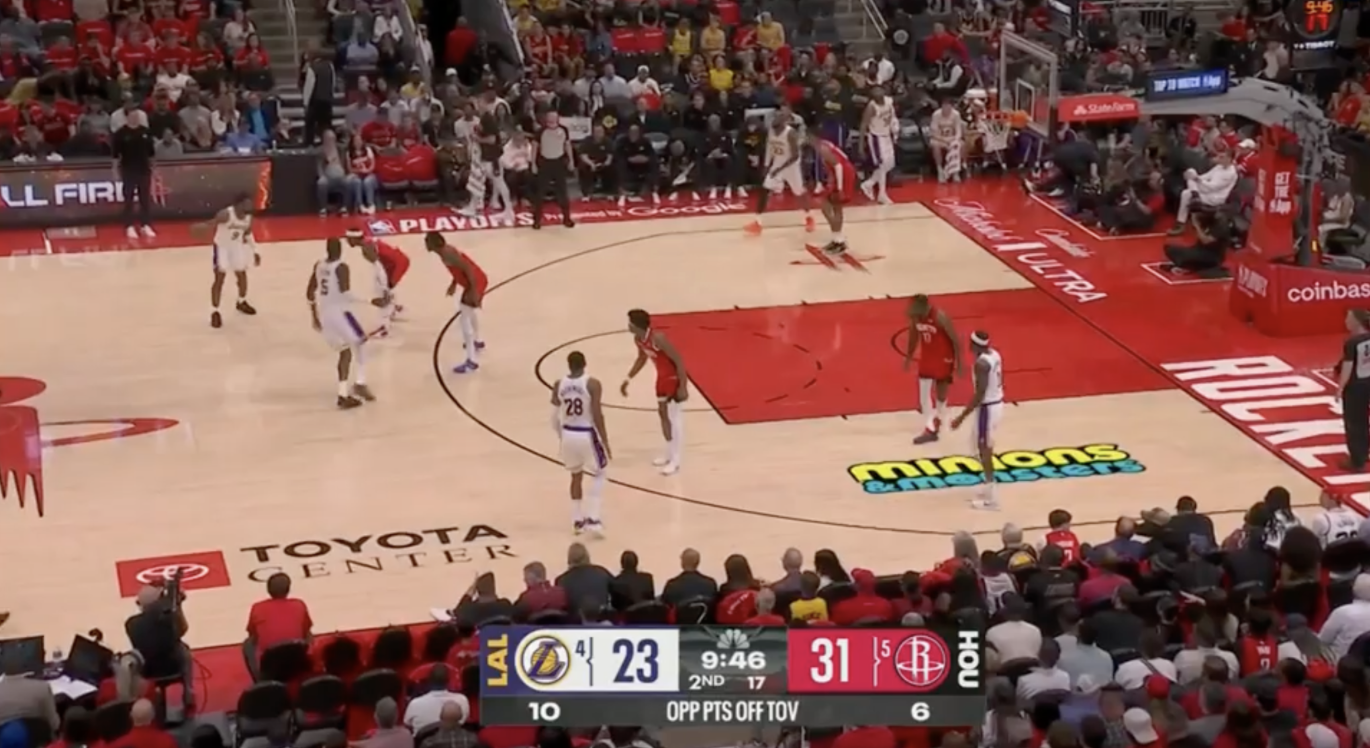
Being further out and closer to the opposition allows for more aggression, particularly in the passing lanes, where the Rockets rank No. 1 among playoff teams with 91 deflections. Houston also tied a franchise-record in steals in Game 4 with 17, with Smith and Eason combining for 8. Smith’s presence, experience as a small ball center and physicality continue to be extremely useful tools for Udoka as the Rockets extend the series.
“We’ve played them four times now, so you kind of know the tendencies of guys,” Smith said. “You know some sets they run. I’m just trying to use my voice as much as I can to help people be in spots, fly around and help. Try to stop what they’re doing.”